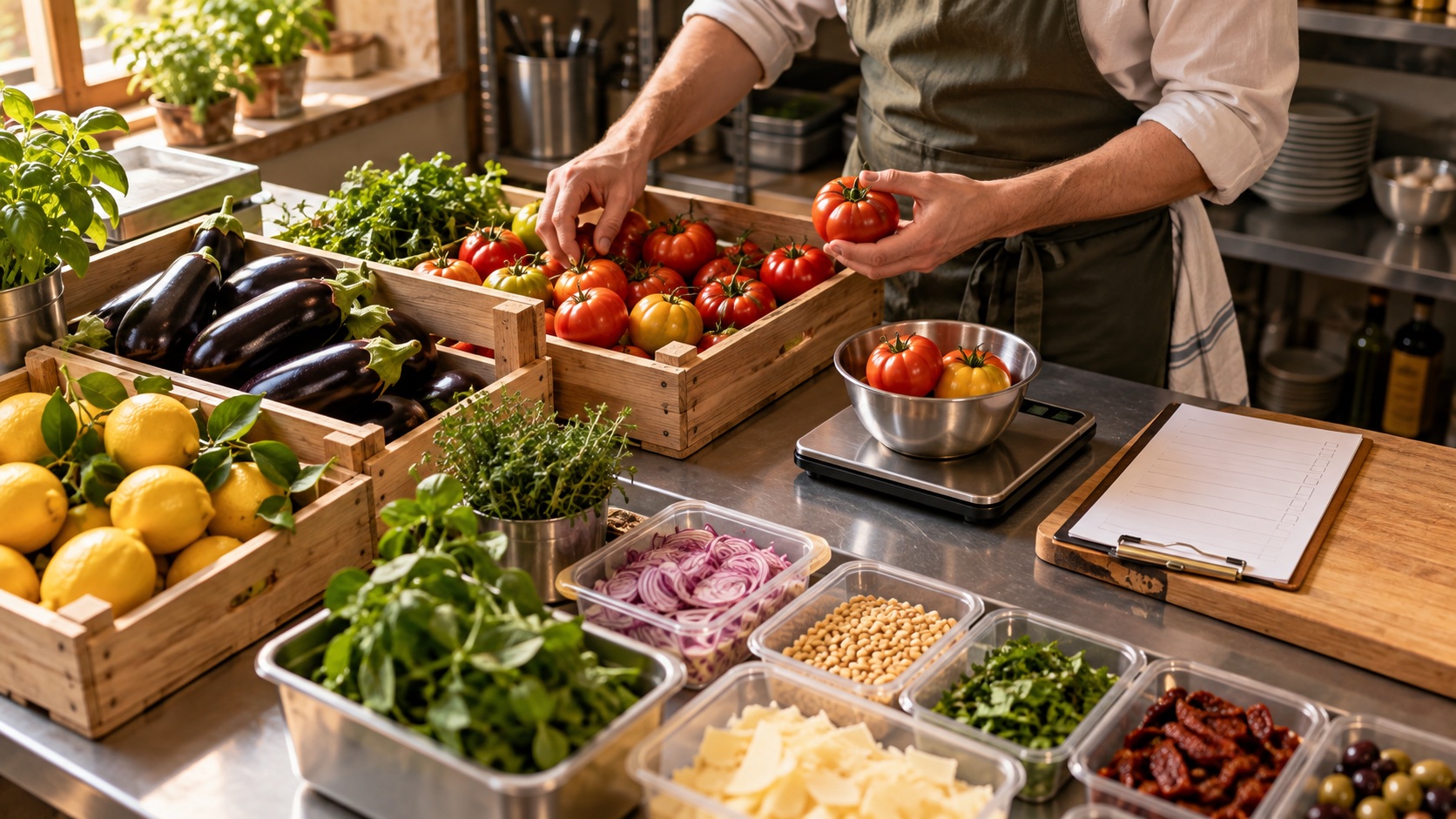
A product runs out even though the tracker still showed it as available. Another gets ordered a second time because no one saw it in the back. Inventory quickly becomes painful when purchasing, prep, and service tell three different stories.
To start, there's no need to measure everything to the same precision. Pick a few important products and build a routine the team can actually keep up.
1. Choose the products to track first
Draw up a short starting list: expensive ingredients, items that often run out, food that regularly gets thrown away, and products used across several dishes. This list is a starting point, not a replacement for your full inventory.
For each product, note where it's kept, who counts it, and in what unit. Counting cases sometimes and units other times makes the numbers hard to compare.
If you buy a case of twelve bottles and track sales by the bottle, record that conversion clearly. For an ingredient you weigh, choose one reference unit and use it at every step.
2. Check what comes in at delivery
Match what arrives against what was expected: item, quantity, and any discrepancies. A partial delivery or a substitution should be noted the moment you spot it.
Then put products away in their usual spot. Stock scattered across several forgotten zones can make an item look missing when it's simply hard to find.
Organize rotation based on the applicable dates and your storage procedures. The goal is to make the products to use first visible, without improvising a food-safety rule.
3. Separate expected use from actual loss
Sales explain part of what leaves your stock. They don't necessarily explain prep mistakes, damaged products, staff meals, or other internal uses.
Record those movements with simple reasons. A short list of a few well-used causes is more useful than a detailed catalogue no one fills in.
For example, distinguish "prep," "plate return," "unused product," and "internal use." These categories are there to help you understand the gaps; they shouldn't become a tool for pointing fingers.
4. Compare expected stock with counted stock
The basic math is simple: starting stock, plus what came in, minus the recorded outflows. Then compare that result to a physical count taken at the same reference point.
Illustrative example: you start with 24 bottles, receive 12, and record 20 outflows. Expected stock is 16 bottles. If you count 14, the gap of 2 bottles is a question to look into, not a conclusion about its cause.
Check the units, the deliveries, the missed movements, and the entry errors first. If a theoretical count relies on recipes, also confirm the planned quantities match the portions actually made.
5. Measure before you choose an action
Before changing your purchasing, watch losses across several comparable services. Note the product, the quantity, the likely cause, and the context. One unusual day doesn't necessarily describe how you normally run.
Starting from a simple diagnosis — rather than a hunch — is the reliable way to build a waste-reduction habit. Look at where losses actually happen, then work on the stock steps and on training the team.
From your observations, choose one action: revisit a prepared quantity, flag a product in the back more clearly, or fix an entry unit. Then check what changes, without promising a savings percentage in advance.
A routine to adapt to your team
- At every delivery: check and record the quantities received.
- At every incident: note the quantity involved and a reason.
- Before service: check the critical items and their availability.
- On a fixed schedule: count the priority products and review the gaps.
- At the team review: choose one fix and track its effect.
Adjust how often you count based on each product's value, turnover, and fragility. A short routine, kept up regularly, will give you a more reliable base than an ambitious system abandoned after a week.
Your next step: choose your first items and line up their units. To talk through your setup, contact the RiseResto team or explore the platform.
Ready to simplify your restaurant?
RiseResto is in open beta — onboard your restaurant today.
Get started free →